The back story
From the frog ditch to the Bahnhofstrasse: how Zurich learned to shop, the back story
From a filled-in moat to watches, chocolate and a flea market: the story of Zurich’s shopping.

Photo Credit
Image courtesy of © Ank Kumar · CC BY-SA 4.0 via Wikimedia CommonsThe Bahnhofstrasse was laid over a town moat called the frog ditch, and within a few decades it held the banks, the watchmakers and the city’s first great department store. Here is how a drainage scheme became one of Europe’s best-known shopping streets, why so many of its names come from Lucerne, and where Zurich goes when it wants a bag made from a lorry tarpaulin instead.
A moat with ambitions
Zurich’s grandest shopping street began as a drainage job. In 1854 work started on filling the Fröschengraben, the old town moat whose name means the frog ditch, and in 1865 the Bahnhofstrasse opened to traffic between the Paradeplatz and the station. By 1877 it ran its full length; its own association now counts 1,400 metres of shopping, and not a single frog.
The oldest clock in the window
Time is the street’s oldest stock. Beyer traces its name to 1760, when a watchmaker called Beyer appears in the records of Donaueschingen in Germany. Stephan Beyer brought it to Switzerland in 1822, a shop opened on the Niederdorfstrasse in 1860, and in 1877 the business reached the Bahnhofstrasse. It has stood at No. 31, in the Orell Füssli building, since 1927: eight generations, two addresses on one street.
The next chapter is already in the diary. Beyer says that from early 2027 Patek Philippe will acquire the business, which will continue as a Patek Philippe boutique. Its clock and watch museum, opened in 1971 as the Museum of Timekeeping, is moving to the Mühle Tiefenbrunnen in Seefeld and expects to reopen in autumn 2027. Few shops have ever changed hands with such punctuality.
Two houses from Lucerne complete the line-up. Bucherer began in 1888, when Carl Friedrich Bucherer and his wife Louise opened a watch and jewellery shop there; in 1924 their son Ernst entered a partnership with Hans Wilsdorf, the founder of Rolex, and since 2024 Bucherer has itself been part of Rolex. A supplier became a partner, and a century later the partner became the owner.
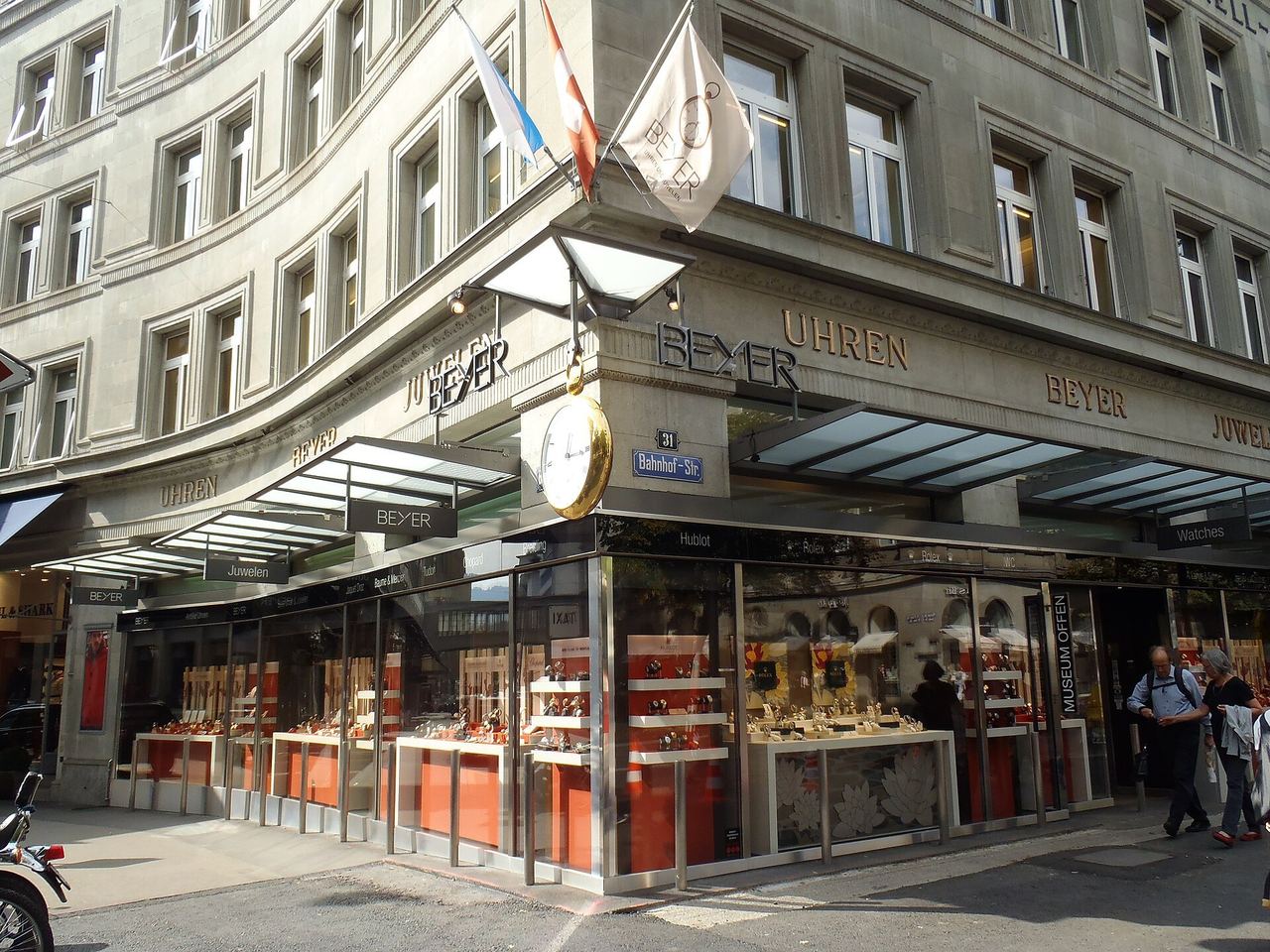
Photo Credit
Image courtesy of © Natalia Sverdlova · CC BY-SA 3.0 via Wikimedia CommonsGübelin’s story is the more romantic. In 1854 Mauritz Breitschmid opened a watchmaker’s shop on the Pfistergasse in Lucerne; his apprentice, Eduard Jakob Gübelin, married his master’s daughter in 1886 and became his partner the same year. In the 1920s the house set up a small gemmological laboratory to test the stones its own jewellers used: trust, but verify, preferably under magnification.
A bazaar beyond compare
The department store came with Parisian ambitions and no false modesty. In 1892 Josef Weber opened Zurich’s first large department store and called it the Bazar ohne Gleichen, the bazaar beyond compare; in 1907 it became a company under the name Magazine zum Globus. Globus Bahnhofstrasse, on the Schweizergasse, and the food hall of Globus Bellevue across the river carry the name today.
Few shops have ever changed hands with such punctuality.
The Schweizer Heimatwerk has a gentler origin. It began almost a century ago to help mountain farmers through the long winters by selling what they made at home, and in November 1931 it became a non-profit cooperative. Its Bahnhofstrasse shop is built into the Swiss National Bank’s building at the Bürkliplatz, which makes it perhaps the most securely housed craft shop in the country.
Sweets, tarpaulins and Saturday treasure
Chocolate is the street’s sweetest export. Läderach began in 1962 as a small chocolate factory in Glarus and now counts more than 300 chocolateries in over 30 countries; its Bahnhofstrasse shop stands near the station. Vollenweider, a Winterthur confiseur since 1943 and on Zurich’s Theaterstrasse since 2008, has the better boast: the astronaut Claude Nicollier never flew into space without its chocolate.
Zurich West sells from old industry. FREITAG makes its bags from used lorry tarpaulins that have spent an average of six years on the road, and sells them from a 26-metre tower of shipping containers by the Hardbrücke. Every Saturday from May to October, the flea market on the Bürkliplatz, founded over 50 years ago, spreads more than 230 pitches of antiques, vintage clothes and art beside the lake.
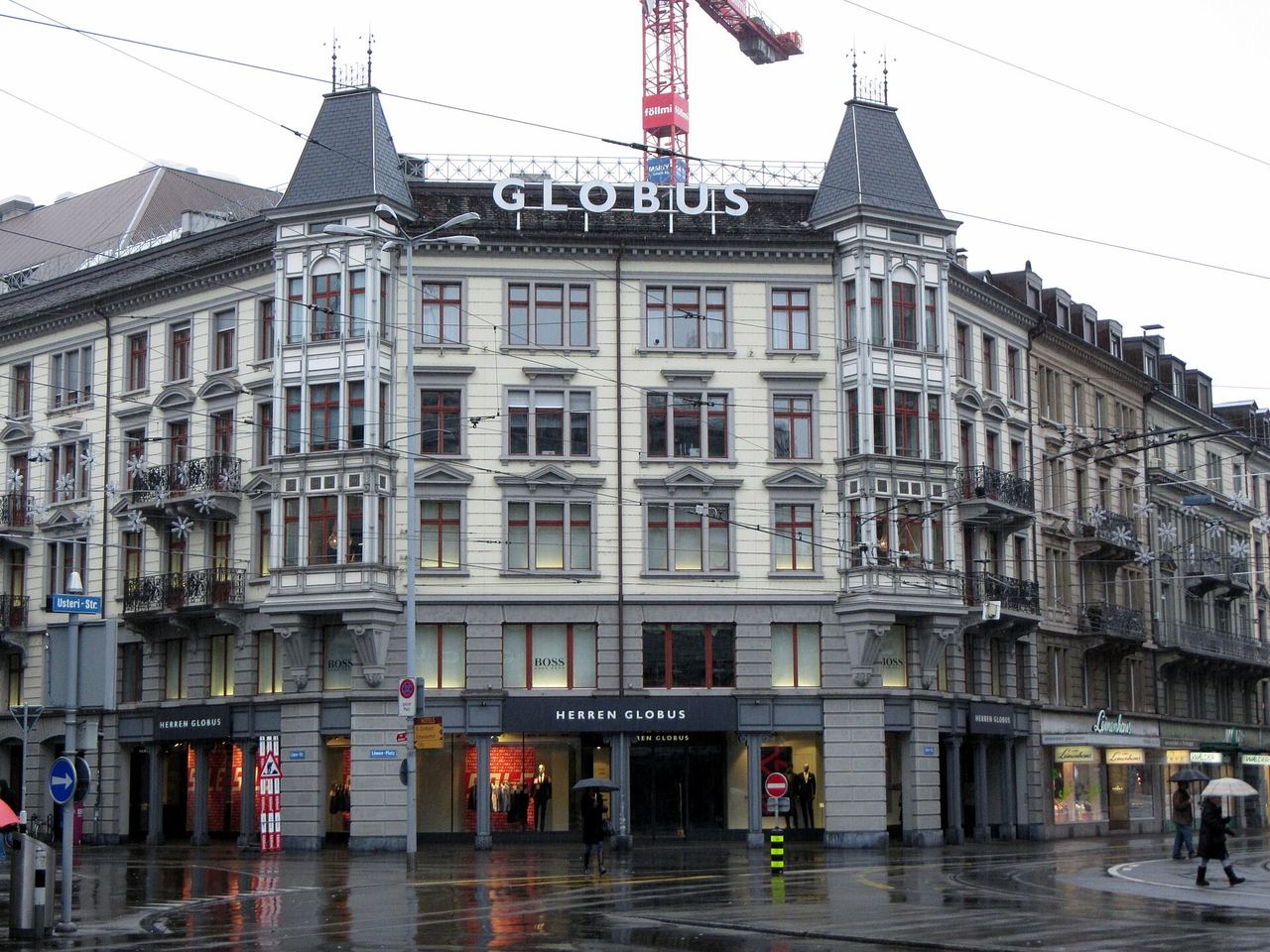
Photo Credit
Image courtesy of © Bohao Zhao · CC BY 3.0 via Wikimedia CommonsOur advice: walk the Bahnhofstrasse from the station to the lake on a weekday morning, before the crowds, and detour to the Heimatwerk at the Bürkliplatz. Keep Saturday for Zurich West and, in season, the flea market. Watches are best seen by appointment; chocolate needs none.
Why it's on our list
- A moat with ambitions
- The oldest clock in the window
- A bazaar beyond compare
- Sweets, tarpaulins and Saturday treasure
Location
The map comes from Google Maps, which sets its own cookies once it loads.
More in depth
 The back storyThe Zürichberg, the Gold Coast and Zurich West: buying in ZurichThe Gold Coast, Seefeld and how buying works in Switzerland.
 The back storySeventeen members and one car: Zurich and the motor car, the back storyCar sharing born in Seebach, a 1945 importer and Formula E at Enge: Zurich and the motor car.
 The back storyZurich by tram, train and boat: the ZVV, the S-Bahn and the lake boatsTrams, S-Bahn and lake boats on one ticket, and trains to the Alps.